
The next big companies integrate AI at their core: it changes all their services, at a scale that was impossible to imagine before. At Sabai System, we take ambitious companies on the journey to becoming AI-native, and here is why it matters for your business.
A world where agents are everywhere
Picture a few years from now.
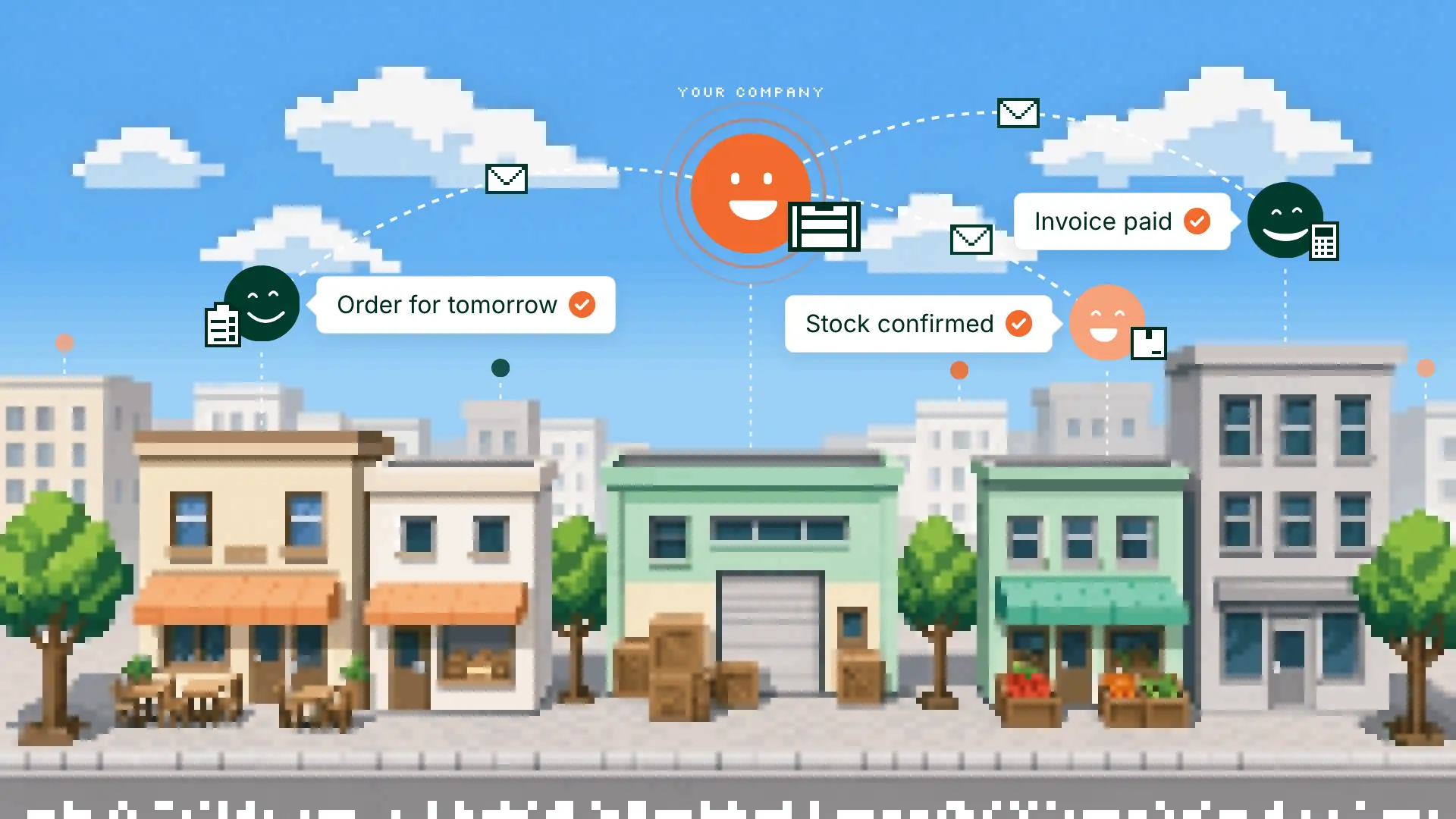
Your clients no longer fill in your contact form. They hand the job to their own agent: it finds a supplier, compares prices and places the order, talking directly to your agents. Your suppliers, your bank, your carrier and your accountant work the same way: their agents send, ask, check and confirm, at any hour.
Inside your company, agents run much of the daily operations. One takes the orders, another plans the deliveries, another checks every invoice. They hand work to each other, and a lead agent coordinates them, the way a manager runs a team. When the business needs a new tool, agents help build it in days.
All day and all night, agents talk to agents: between your teams, and between your company and everyone it works with. A large part of the work gets done this way.
In that world, a company has to be ready for agents. Ready inside, so its own agents can read its information and follow its rules. Ready outside, so the agents of its clients and partners can find its prices, check its stock, place an order and get an answer in seconds. A company their agents cannot talk to is a company they skip.
That can sound scary. It is also very good news:
- People keep the work that matters: clients, decisions, ideas, the work they are proud of.
- A small company plays like a big one. Five people can serve clients in six countries, in their language, at any hour.
- Everything moves faster. Answers in minutes, orders in seconds, mistakes caught before they reach a client.
- Each piece of information is typed once, and the chasing runs by itself.
- The business keeps running when the owner takes a week off.
The pieces of that world already exist:
- Agents that work for hours. Since 2023, the length of task an agent can finish on its own has doubled about every four months. The best ones METR tested in May, some not yet released, take on software tasks that would keep a person busy for two full working days.
- Agents that lead other agents. In Claude Code, one agent acts as team lead: it splits the job, hands the pieces to other agents and puts the results together.
- Personal agents. OpenAI’s dots, Grok Bot and Meta’s Muse work on their own computer in the cloud and take on tasks for you, and keep working while you are away.
- Agents that sign in for you. With 1Password, an agent logs in to your accounts once you approve, and the password stays hidden from it.
- An ID for every agent. Microsoft and Cloudflare give agents an identity, so a business or a website can check which agent is acting. At Microsoft, every agent also has a person who answers for it.
- Agents that pay. Agents built with Cloudflare can already pay for online services.
Most of these launched in the past year, the personal agents in the past three months, and it is speeding up. That world is starting now. The companies built for it are AI-native.
What an AI-native company is
An AI-native company is designed around agents: they do a large part of its work, its people direct them and answer for the results, and it is ready to work with other companies’ agents.
Two words matter here. An assistant answers when you ask: you stay at the keyboard, it helps. An agent takes on a task and does it, for someone on your team. It runs on a schedule, or when something happens, like an email arriving, works with other agents, and stays within the limits that person set. Today most companies use assistants. The world above runs on agents.
Each part of the definition is something you can check in your own company:
- Agents do a large part of the work. Checking, preparing, drafting, following up, on your own clients, orders, prices and procedures, so the work fits your business.
- People direct them and answer for the results. You decide what each agent may read, what it may do alone and what waits for a person’s yes. The judgment, the relationships and the decisions stay with your team.
- It is ready for other companies’ agents. Your clients’ and partners’ agents can find your prices, check your stock, place an order and get an answer, within your rules. This part is only starting, which makes it an opening for the first companies ready.
A day that never stops
An AI-native company has a different kind of day, because its agents keep working when the office is closed. Picture a food distributor, made up for this article, that supplies restaurants: a warehouse, a few sales reps on the road, an office team and an accountant.
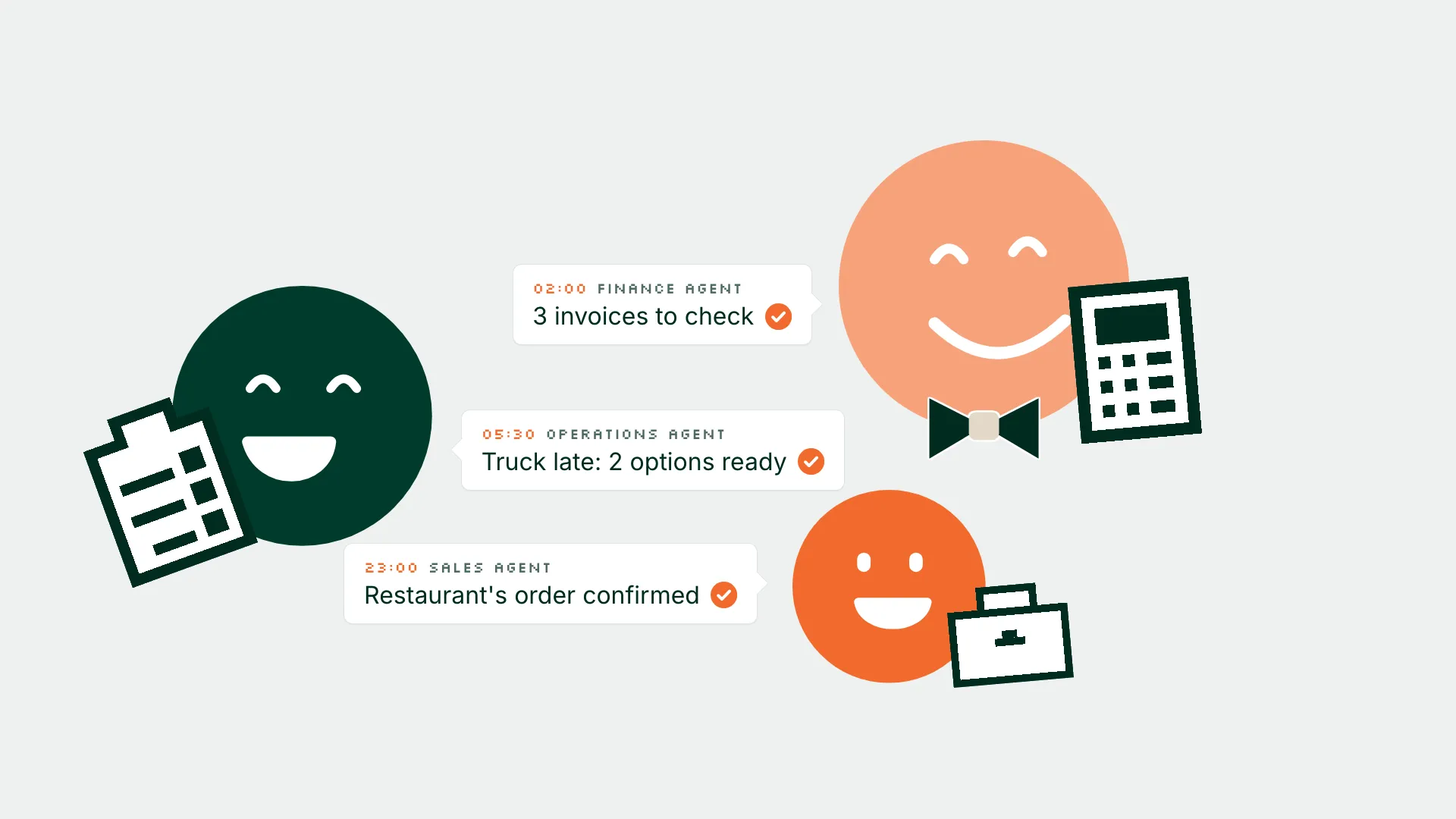
02:00 The finance agent checks yesterday’s deliveries against the invoices sent. Three do not match, and it sets them aside for the morning.
05:30 A supplier emails: the truck will be four hours late. The operations agent works out which deliveries it affects and prepares two options: buy from another supplier, or move three deliveries to the afternoon.
07:30 The operations manager opens the morning brief: today’s deliveries, the three invoice gaps, the late truck and the two options. The decision takes a minute. On spreadsheets, the same picture took an hour, three files and the inbox.
09:00 Orders arrive by email, PDF and WhatsApp. The sales agent reads each one, enters it, and checks the stock and the client’s prices. The sales manager approves the one discount outside the usual rules. Each order is typed once, by the agent.
11:00 At a restaurant, the sales rep asks the assistant on their phone for the last orders, the unpaid invoices and the dishes this client stopped ordering. The answer comes from every tool the company uses, with its sources. The quote is ready at the table; the rep negotiates and signs.
14:00 The finance agent matches each supplier invoice with its order and its delivery, and prepares the payments. Known suppliers under the limit the owner set get paid. The accountant looks at the new ones, the large ones and the ones that do not match.
18:00 A restaurant group receives its weekly report: what each dish cost them this week. An agent built it from the group’s own orders, the account manager checked it, and the group pays a monthly fee for it. On spreadsheets, nobody had the hours to offer it.
23:00 A restaurant’s own agent places tomorrow’s order. The distributor’s agent answers on price, stock and delivery time, within the rules the company set. The account manager finds the order in the morning brief.
Each person in this story spends the day on clients, exceptions and decisions. Agents carry the rest, day and night.
It already works
This already runs today, from the most advanced tech companies to the workshop.
Ramp, the US fintech, shows how far it can go. Its own coding agent, Inspect, now opens three quarters of the code changes its engineers merge. Feature requests from customers used to be copied by hand, about 300 a month; AI now pulls them from customer calls, 20,000 a month, and emails each customer when what they asked for ships. Ramp also sells agents to its customers: they check expenses against company policy and, Ramp says, handle 85% of expense reviews.
It is not only for tech companies. A machine shop, a sheet-metal workshop and a plumber already put AI to work.
Fårbo Manufacturing, a Swedish machine shop of about 60 people, makes metal parts for industrial groups such as Epiroc and ABB. An AI agent called Maria reads customer emails and their PDF attachments, and enters each order in the company’s system, day and night. Other agents order from suppliers and manage the stock. Almost everyone now works in production, where the parts are made.
EIST, a French sheet-metal workshop in Lyon with five employees, taught an AI its own past jobs. The AI now reads the 3D file of a new part and prices it in about ten minutes, against up to two hours before. The owner still checks every quote before it goes out. Before, some requests went unanswered for lack of time.
Hans Schramm, a German plumbing and heating firm in Munich with about 100 people, in its fifth generation since 1897, has an AI voice agent called Paul. Paul answers the phone, asks the right questions, finds the customer’s file and passes the job to the right person, more than 1,000 calls a week. Callers are told they are talking to an AI, and the team can see every conversation.
What it opens for your business
The hours saved are the first gain. The bigger one is what the company can now sell.
- Services you had no time for. Reports, checks and follow-ups that clients would pay for. AI prepares them, a person signs them off.
- Speed that wins deals. An answer in minutes, a quote at the table, a delivery status at any hour. The first good answer often gets the order.
- Small clients worth serving. Accounts that cost more to handle than they brought in become worth it once AI prepares most of the handling.
- New markets and languages. Answer, quote and send documents in each client’s language, from your own office.
Size is no barrier. With an assistant that knows every client and agents that run tasks each night, a firm of five gives its owner’s day back to selling.
This used to be software’s advantage. A software company serves its thousandth customer with the team that served its tenth; a service firm needed more people for every new client. Agents bring that advantage to services.
How to start, on your own
You can try most of this yourself this week, with tools that are ready to use.
- Pick an assistant for the team. Claude, ChatGPT, Microsoft Copilot or Google Gemini, on a business plan: Claude and ChatGPT cost $20 to $25 a person a month, Copilot about the same on top of Microsoft 365, and Gemini comes with Google Workspace. Give everyone a company account.
- Connect your tools to it. In the assistant’s settings, look for connectors (MCP). Claude and ChatGPT connect to Gmail, Google Drive, Microsoft 365, HubSpot, Notion and many more in a few clicks. From then on, the assistant answers from your real information.
- Write down how you work. Keep your procedures and decisions in one place your assistant can read once it is connected. A notes tool such as Notion or Obsidian works well, and a meeting recorder such as Granola can capture what gets decided in meetings.
- Give AI one task every day. Use the assistant’s scheduled tasks: a summary of your inbox and calendar each morning, the list of unpaid invoices every Monday. Check what it gives you, and correct it.
- Try an agent. OpenAI dots, Grok Bot or Hermes Agent take on tasks across your apps. Start with one task, and decide what it may do alone and what it must ask you first.
Then count the hours each task gives back. The tasks that work show where your company becomes AI-native first.
What we build at Sabai System
What excites us most is that a small company can now run like a much larger one, with the team it has.
It is a change of paradigm, and investors see it too. Sequoia argues that the next trillion-dollar company will be a software company that looks like a service firm: it sells the work, not the tool. For every dollar spent on software, six are spent on services. For us, it means every small service company can become a tech company, with agents doing a large part of the work and its people leading them.
This is what we build for our customers. We connect their tools, bring their information into one place, and build the agents that do the work, under their rules. Their team delivers more of the finished work, and spends its days on clients and decisions.